Musbury Heights Quarry: A Window into Rossendale's Industrial Heritage
These stone slabs, used for pavements and roofs during the Industrial Revolution, still leave their mark on the region today.

By David Hodgetts
Published On 2023-06-09
Musbury Heights Quarry: A Window into Rossendale's Industrial Heritage

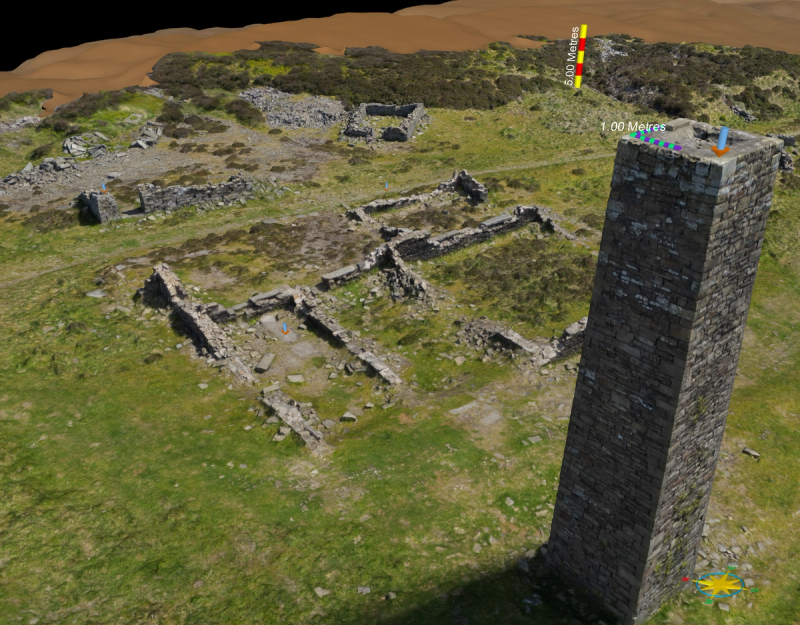
Rossendale, a region steeped in industrial history, is home to numerous heritage sites that tell the story of its past. Among these sites is Park Quarries at Musbury Heights, a significant landmark that played a vital role in the rise of the Industrial Revolution. With its working life spanning from 1877 to the mid-1920s, the quarry and its associated features offer a glimpse into the bustling quarrying industry of the time.
We chose to build a model of the old quarry site to show how the techniques used for digital outcrop modelling can be applied to multiple disciplines, and also as it's of local interest. The data was collected using a DJI mini Pro 3 and took about 1 hour to collect.
The Haslingden Flags:
The Namurian age Haslingden Flags, part of the Carboniferous Millstone Grit Group, comprises a variety of lithologies from mudstone through siltstone, to ripple cross-laminated and cross-bedded medium-grained sandstones. The flags are divided into the Upper and Lower Haslingden flags, with a wide range of thickness. The depositional environment of the Haslingden Flags is described by Collinson and Banks (1975) as comparable to present-day deltas such as Mississippi and Colorado.
Flagstone Production:
Musbury Heights Quarry, founded by Hargreaves and Bolton in 1877, quickly became a hub for the extraction of the Haslingden Flags. These durable stone slabs were in high demand during the Industrial Revolution, finding use in flagstone pavements and occasionally even roofs. The quarry's large size and the quality of its stone made it an ideal location for such production. Even today, Haslingden Flags can be found throughout the region. The flagstones were often used as walls between fields, and are quite distinctive.

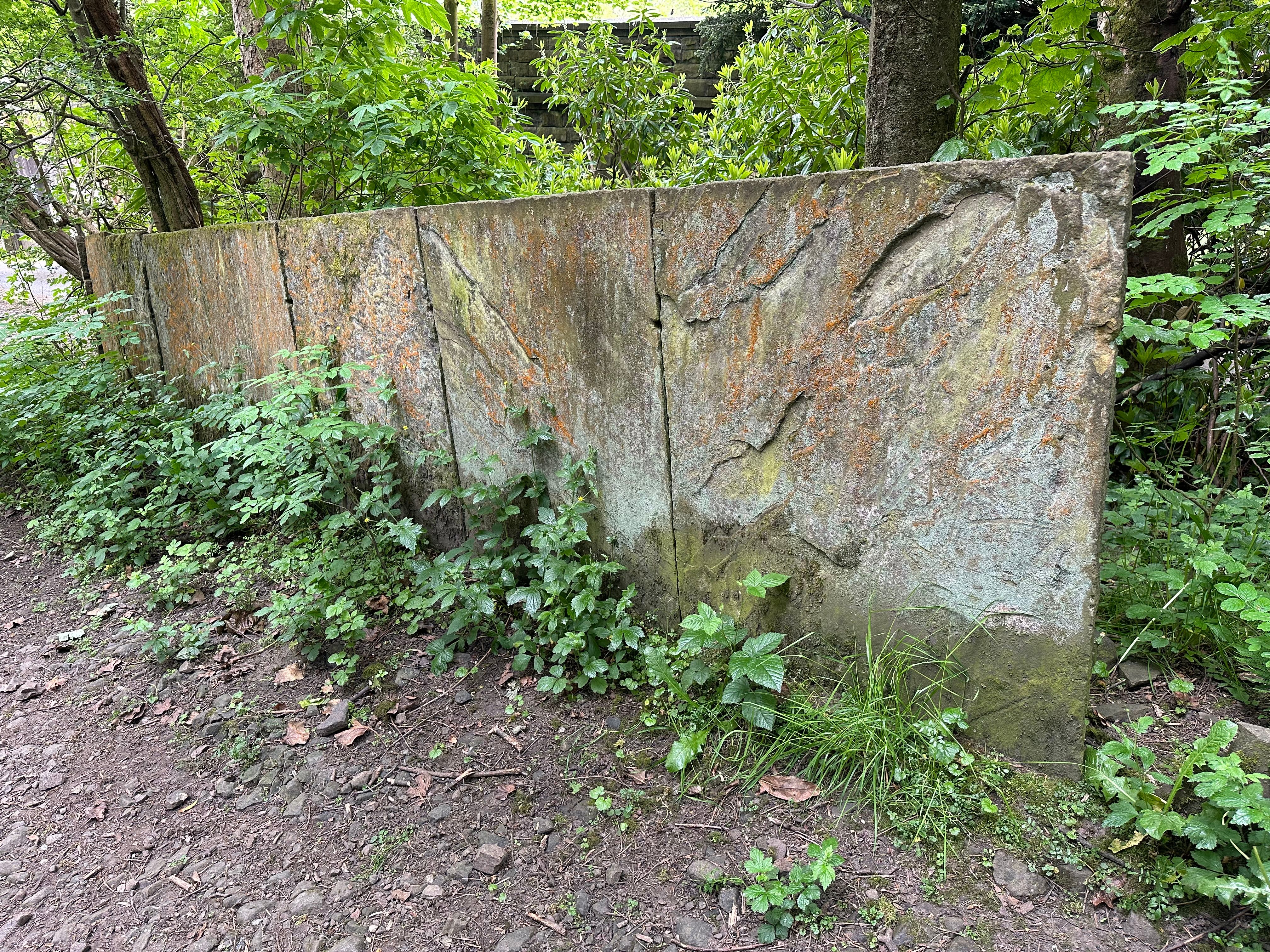
The Haslingden Flagstones are found locally as walls, and even as roofing tiles.
The Tramway:
An essential part of Musbury Heights Quarry's operations was the Haslingden Grane Tramway. This tramway, which ran between Hutch Bank and the Musbury Heights quarries, transported materials and resources necessary for the quarrying process. Its well-defined incline to Musbury Heights is still visible and a reminder of the tramway's vital role in the quarry's success. The path of the tramway is still visible, and even some of the sleepers can be found if you look carefully.
Structures and Features:
Exploring the quarry site reveals a range of structures and features that once buzzed with activity. The Scrubbing Mill housed machinery used to cut, dress, and polish the rough stone into flags, and the scrubbing mill chimney is still visible today. Several other buildings are still visible, one of which has a machine base and another may have been part of a crane system, but much of the evidence of what they were used for is now gone.
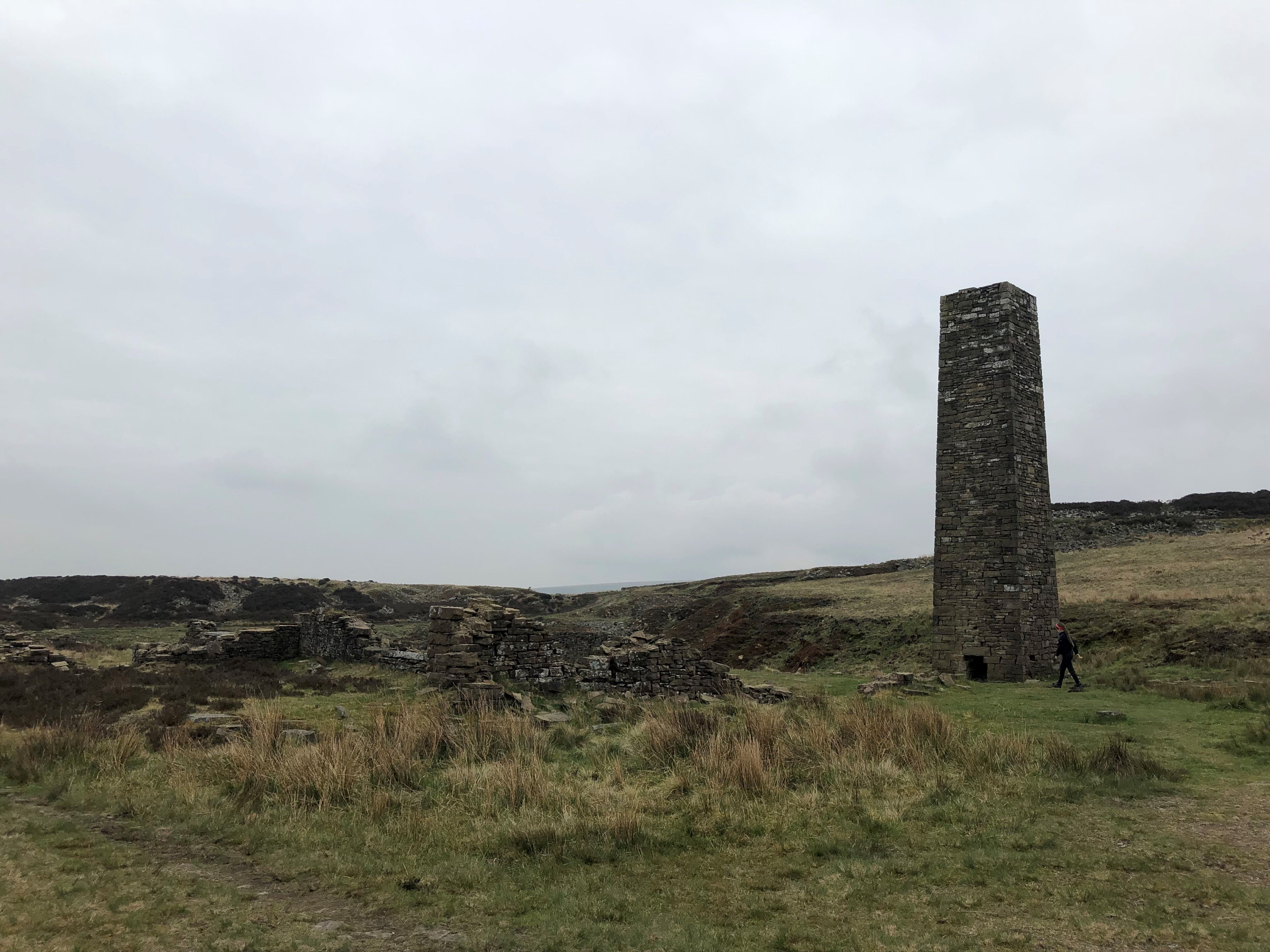
The Scrubbing Mill Chimney at Musbury Heights
Legacy and Conservation:
The legacy of Musbury Heights Quarry extends beyond its working years. It is said that Trafalgar Square may contain Haslingden Flags sourced from this very quarry, further emphasizing the enduring impact of the stone and the quarry itself. Recognizing its historical and cultural significance, efforts have been made to conserve and protect the site. The restoration of the Scrubbing Mill chimney in 2004, made possible through funding from English Heritage, highlights the importance placed on preserving the quarry's structures and heritage for future generations.
Conclusion:
Musbury Heights Quarry stands as a testament to Rossendale's industrial heritage. Its historical significance as a hub for Haslingden Flagstone production, coupled with the tramway and various quarry structures, offers a fascinating insight into the quarrying industry of the late 19th and early 20th centuries. As we explore and appreciate sites like Musbury Heights Quarry, we gain a deeper understanding of the industrious past that shaped the regions we know today.
References:
J. D. Collinson and N. L. Banks, 1975. The Haslingden Flags (Namurial G1) of South-East Lancashire: Bar finger sands in the Pennine basin. Proceedings of the Yorkshire Geological Society}, Vol 40, No 3, pages 431-458.
Industrial Heritage: A guide to the industrial heritage of Haslingden and Hemlshore. Mike Rothwell. 2008. Bridgestone Press.
A guide to the Rossendale Way: Jack Woods. 2011. Sigman Leisure.
Websites: http://www.valleyofstone.org.uk/journey/heritagesites/musburyheightsquarry
https://www.visitlancashire.com/dbimgs/Musbery-walk.pdf
Haslingden Flags BGS lexicon
https://data.bgs.ac.uk/id/Lexicon/NamedRockUnit/HS
Latest Articles