Python and Digital Outcrops

By Brian Burnham
Published On 2024-08-22
Last Edited : 2024-08-22
Python and Digital Outcrops

In case you’ve been living under a rock (which might be true as a geoscientist!), Python use, as a tool in geosciences, has significantly increased in the past decade. This increase is reflected in the number of publications that use Python as part of their data analysis workflow/methodology published over the past decade (see plot below).

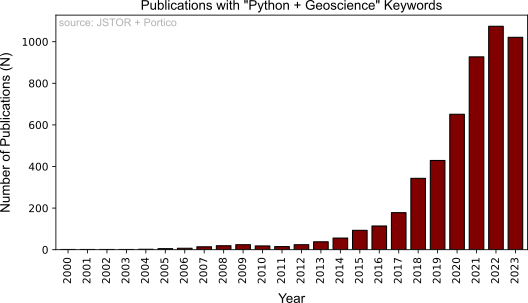
The increase in the number of publications with geoscience and python keywords.
Python’s ease of entry to programming, and ubiquity in scientific computing, has partially contributed to this rise, so it’s no wonder that we’ve seen this increase in the geosciences. There’s a plethora of open-source Geoscience-specific Python packages that geoscientists have created and use to unravel the mysteries of this Pale Blue Dot we call home. There’s even a curated list of “Awesome Open Geoscience” software packages (not all in Python) that you should check out showing what the geoscience community has been cooking up in the open-source software ecosystem.
I’ve been using Python and general “Data Science” techniques to analyse geoscience data for some years now, including attending hackathons with a specific focus on visualisation. I’ve been building and analysing digital outcrop data for even longer, so the integration of both is a significant step forward to extracting more data from digital outcrops. The Python interpreter in VRGS gives me access to more of the digital outcrop data because it can leverage the abundant and openly accessible Python tools at our disposal. Below are the current Python methods available in VRGS – all accessible by simply importing the VRGS Python library.
# Import VRGS Python methods
import vrgs

# Return the number list of meshes in the project
vrgs.mesh_list()

# Return the list of point clouds in the project
vrgs.pointcloud_list()

# Return the list of vertices in a mesh_list
vrgs.meshvertices()

# Return the list of vertices in a point cloud
vrgs.pclvertices()

# Return the number of attributes of a mesh
vrgs.meshattributelist()

# Return the number of the attributes of a point cloud
vrgs.pclattributelist()

# Return the attributes of a mesh
vrgs.meshattribute()

# Return the attributes of a point cloud
vrgs.pclattribute()

# Add attributes to a mesh after computation
vrgs.addmeshattribute()

# Return a list of all orientations in the project
vrgs.orientations()
At VRGeoscience Limited, we are passionate scientists, innovators, and educators dedicated to providing geoscientists with the best tools to unlock more from their digital data. We continually develop new software and techniques to extract more information from digital outcrop data that empowers geoscientists in their work and research.
If you use 3D digital outcrop in your work/research and are a keen Pythonista (what we Python developers call ourselves!), give the Python interpreter in VRGS a go and let us know what you come up with, we’d love to hear about it! We also have some examples (all MIT licensed) on our VRGS-Python Github page, with more updated frequently. Keep an eye out for more.
Let’s take the digital geosciences further with VRGS and Python – Happy digital geologising!
References
Burnham, B. S., & Hodgetts, D. (2024). VRGS-Python (Version 0.1.0) [Computer software]. https://doi.org/10.5281/zenodo.12168786
Latest Articles